PAC-MAN 256 - Endless Maze
- 4.2
- Rating
- 10.00M
- Installs
- Free
- Price

 Analysis by App-foxy
I first understood the appeal of PAC-MAN 256 within a few seconds: choose a direction, turn before the maze closes in, collect what is nearby, and keep moving because stopping is usually worse than taking a risk. It is an arcade game built around immediate decisions rather than a long tutorial or a complicated story. That makes it easy to pick up when I have only a short break, but it also gives every mistake enough weight to make me try again.
The game comes from BANDAI NAMCO Entertainment Europe and is free to play. It belongs to the arcade category, carries an Everyone age rating, and works on devices running Android 5.0 or later. Its store summary describes an endless maze from the creators of Crossy Road, but that comparison only explains the broad idea. In practice, this feels like a fast, modern take on classic PAC-MAN rules, with the familiar chase transformed into a run where the maze itself is part of the danger.
Why the first move matters more than the last one
The opening action is wonderfully simple. I guide PAC-MAN through the maze, decide whether to take a safer turn or chase something valuable, and immediately read the result from the movement on screen. There is no need to learn a large control scheme. The challenge comes from timing and route choice: a direction that looks safe now may become a trap a moment later.
You May Also Like

 Blood Strike: 2.5 Anniversary
Blood Strike’s Loadouts Turn Every Drop Into a Tactical Gamble
A close look at Blood Strike’s custom loadouts: how fast access to signature weapons reshapes its battle royale rhythm, rewards preparation, and narrows the gap between fights.

 Pandora - Music & Podcasts
Pandora’s Music Is Easy to Start, but Harder to Recover
Pandora’s strength is its low-effort path from a seed to a station. Its weak spot is how much confidence it asks you to place in connection, setup, and quiet recovery.

 8 Ball Pool
 Is Built on Rivalries, Rematches, and Routine
A close look at the rivalries, rematches, shared routines, and unanswered safety questions that turn a quick pool match into a persistent mobile community.

 Samsung Music
’s Quiet Strength Is Playing What You Already Own
Its reach comes less from spectacle than from dependable access to a personal library. That simplicity is both the app’s strongest retention engine and its ceiling.

 AccuWeather: Weather Radar
AccuWeather Review: A Quick, Clear Forecast for Everyday Decisions
For everyday plans, the best forecast is the one you can understand quickly. AccuWeather makes rain timing, radar, and local conditions easy to act on, with a few trade-offs.

 Hill Climb Racing
Why Hill Climb Racing Still Turns Crashes Into One More Run
A tiny car, a bumpy hill and one more upgrade: Hill Climb Racing keeps resurfacing because its simple chaos makes every near-miss feel personal.
More From Our News Desk



That simplicity is especially useful on a phone. I can begin a session without setting aside time to remember several abilities or understand a complicated objective. The game communicates through movement, sound, enemies, and the changing maze. When I make a poor turn, I usually know why. That clarity is important in an arcade game because it makes failure feel like a lesson rather than a random interruption.
The maze does not give me the comfort of a fixed level that I can memorize once and finish permanently. Each run asks me to stay alert. I am not simply following a route I practiced earlier; I am reacting to what is in front of PAC-MAN and deciding how much danger is worth accepting. That makes the first few seconds feel calm, while the later part of a run becomes increasingly tense.
My most useful habit is to look one or two turns ahead instead of staring only at the next collectible. It is tempting to grab whatever appears closest, but a short-term gain can leave no practical escape route. I get better results when I treat the maze as a series of exits: before moving toward a reward, I check where I can go if an enemy approaches or the path ahead becomes unsafe.
This is one of the less obvious strengths of the game. It rewards spatial awareness more than frantic tapping. Players who enjoy classic maze games will recognize the basic language, but the endless structure changes the mindset. The goal is not merely to clear a board; it is to preserve options for as long as possible.
The feedback rhythm keeps the run alive
The best part of the experience is the rhythm between action and response. I move, the game immediately shows whether that choice worked, and the next decision arrives before I have time to become passive. Collecting items gives the run a sense of progress, while avoiding danger creates a smaller, sharper reward. Even a modest escape can feel satisfying because it confirms that I read the situation correctly.
That rhythm is why the game works better as a short-session arcade title than as something I would play while looking for a long narrative experience. There is no slow build-up needed. A run begins with a clear objective, becomes more demanding as I continue, and ends with a mistake that naturally invites another attempt. The feedback is direct enough that I rarely feel disconnected from what is happening.
The sound and visual reactions also help me judge the pace without constantly analyzing the screen. I can feel when a run has moved from casual collecting to careful survival. That change is important: the game does not need a huge amount of explanation to create pressure. The maze, the approaching threats, and my own limited room to maneuver do most of the work.
Still, the same immediacy can expose a weakness. If I am tired or playing in a distracting environment, a small lapse in attention can end a run quickly. This is not an arcade game I would recommend to someone who wants a relaxed maze puzzle where every move can be considered for a long time. It is more suitable for players who enjoy quick decisions and accept that concentration is part of the entertainment.
Another practical point is that the game is easy to understand but not necessarily easy to master. A new player can begin without reading instructions, yet improving requires noticing patterns in personal mistakes. I learned more by asking why I had entered a dead end than by simply trying to move faster. That makes the feedback loop useful beyond the immediate score: it gradually teaches better route discipline.
Rewards that encourage another attempt
The reward structure works because it is tied to what I am already doing. Moving farther, collecting more, and surviving difficult moments make the current run feel worthwhile. I do not need a separate mission screen to understand that progress is happening. The reward is visible in the run itself, and that keeps the focus on play rather than administration.
The game is free to download, with optional in-app purchases ranging from $0.99 to $4.99 per item. I appreciate that the basic entry point is open to anyone, especially because the core appeal can be tested quickly. At the same time, players who dislike purchase prompts or any form of optional spending should approach it with that structure in mind. I would begin by playing without buying anything and decide later whether the convenience is worth it.
For me, the strongest reward is not a single collectible but the feeling that I handled a difficult sequence better than before. A run can start as a casual attempt and turn into a personal challenge once I realize I am close to beating my previous performance. That is a classic arcade motivation, but this game makes it particularly clear because the maze keeps asking for one more correct decision.
There is also a useful difference between chasing a high result and simply practicing. On a busy day, I can treat a run as a quick reaction exercise and stop after a few attempts. When I have more time, I can focus on improving route choices and resisting the urge to take every tempting path. This flexibility makes the game more approachable than an arcade title that demands a long uninterrupted session.
One tip I would give a new player is to separate survival practice from score chasing. In the first few runs, I would concentrate on staying mobile and preserving escape routes rather than grabbing every nearby reward. Once that feels natural, I would take more calculated risks. This two-stage approach makes the learning curve less frustrating because it prevents every mistake from being treated as a failure to collect enough.
The game is also a good fit for a familiar everyday situation: waiting for a train, sitting through a short break, or winding down before bed with enough attention left for a few quick decisions. I can start, play a complete attempt, and put the phone away without needing to remember a story or manage a large inventory. However, I would not choose it when I need something genuinely calming. The pressure to keep moving can be stimulating rather than restful.
Why the reset feels fair
When a run ends, the reset is part of the design rather than an interruption. I know the next attempt will begin quickly, and I already have a specific adjustment in mind: turn earlier, avoid a greedy detour, or watch the available exits more carefully. That immediate restart is what converts frustration into motivation.
A fair reset needs two things: a clear reason for failure and a believable chance to improve. This game generally delivers both. When I lose because I moved into danger or failed to react, the mistake is easy to connect to my own decision. The next run therefore has a purpose. I am not merely hoping for luck; I am testing a different response.
That said, repeated resets can become tiring for players who prefer steady progression. There is no substitute here for the satisfaction of completing a conventional level and moving on to a new stage with a clear finish line. The endless format is excellent for replayability, but it may feel unsatisfying if your favorite arcade games are built around unlocking a sequence of handcrafted challenges.
I also think the reset makes the game more demanding on attention than its friendly appearance suggests. The PAC-MAN identity is familiar and approachable, but the endless maze does not let familiarity do all the work. Players who expect a simple nostalgia trip may be surprised by how quickly the game asks them to make serious route decisions.
For younger players, the Everyone rating makes the theme broadly accessible, and the controls are straightforward enough to understand quickly. I would still describe the game as better for children and adults who enjoy retrying a challenge than for someone who becomes discouraged by frequent failure. The age rating says the content is suitable; it does not mean the difficulty will suit every temperament.
How it compares with other arcade choices
Compared with a traditional PAC-MAN board, this game places less emphasis on completing one known layout and more on maintaining a successful run through an ongoing maze. That makes it less predictable and more reactive. A classic version may appeal more if you want to study enemy behavior on a defined board. This version is the better choice when you want each attempt to feel like a compact survival challenge.
Compared with endless runners, it is slower in one important way: the main challenge is not simply reacting to obstacles arriving in a straight line. I am choosing turns, weighing nearby rewards, and trying not to remove my own escape options. Someone who enjoys the constant forward motion of a runner may find this more thoughtful, while a player who wants complete control and no pressure may prefer a turn-based maze puzzle.
It also differs from larger mobile games that rely on long progression systems. I do not open it expecting a story, a large world, or a lengthy daily checklist. Its value is concentrated in the run itself. That focus is a strength for quick entertainment, but it is also the reason I would not install it as my only game. It serves a specific mood: I want immediate action, a clear challenge, and a reason to retry.
The developer’s experience with accessible arcade design is visible in that focus. The presentation is approachable, but the underlying loop is not empty. I am always making small judgments about risk, and those judgments become more interesting as the maze grows harder to read. The game does not need to imitate a full console adventure to feel substantial; it succeeds by making a narrow idea replayable.
Who should play, and who should skip it
I would recommend it to anyone who likes classic arcade games but wants a format suited to a phone. It is particularly good for players who enjoy improving through repetition, learning from mistakes, and competing with their own previous performance. It is also a sensible choice if you want a free game that can be understood immediately rather than one that asks for a long introduction.
I would be more cautious about recommending it to players who need a peaceful, low-pressure experience. The constant movement and sudden consequences can make a short session surprisingly intense. I would also suggest skipping it if you only enjoy games with fixed levels, a strong narrative, or a clear sense of permanent completion. The endless structure is the central attraction, so it will not feel like a minor detail to someone who dislikes that format.
On a technical level, the current version is 2.1.1, and the stated minimum operating system is Android 5.0. The game has reached over ten million installs, with an average rating of 4.2 from roughly 465 thousand ratings and around 28 thousand written reviews. Those figures suggest a broad audience, but my decision would still come down to the loop: do I want a maze where every successful move creates the pressure to make the next one?
My verdict on the action-reward-reset loop
My answer is yes, with a clear qualification. PAC-MAN 256 is strongest when I play it in short bursts and accept that the aim is not to finish the maze but to extend a good run through better decisions. The first action is accessible, the feedback is immediate, the rewards make progress feel tangible, and the reset gives each mistake a practical lesson.
Its limitations are equally clear. The endless format can feel repetitive if I am looking for varied objectives, and the pressure may not suit relaxed players. Optional purchases also mean that people who prefer completely purchase-free games should pay attention to the experience around the free starting point. These are not reasons to dismiss it, but they define the audience it serves best.
After a failed attempt, I usually know exactly why I want to begin again: I saw a better turn too late, chased a reward without an exit, or let the pace push me into a careless decision. That is the mark of a successful arcade loop. It turns a tiny mistake into a specific challenge, then makes the next session feel like a genuine chance to do better. For me, that is why this endless maze remains worth keeping on a phone.
FAQs for PAC-MAN 256 - Endless Maze
01What is PAC-MAN 256 - Endless Maze?
PAC-MAN 256 - Endless Maze is an innovative twist on the classic arcade game. Developed by Hipster Whale and 3 Sprockets, it combines traditional PAC-MAN gameplay with an endless maze format. Players must navigate through a never-ending maze, avoid ghosts, and collect power-ups to achieve high scores.
02Is PAC-MAN 256 free to play?
Yes, PAC-MAN 256 is free to download and play on both Android and iOS devices. However, it includes in-app purchases that allow players to buy coins, power-ups, and other enhancements to improve gameplay or advance more quickly through levels.
03What unique features does PAC-MAN 256 offer?
PAC-MAN 256 introduces several unique features, including a glitch that follows players, adding a new layer of challenge. The game also offers power-ups like lasers, tornadoes, and giant mode, ensuring a fresh experience. Additionally, players can unlock a variety of themes to customize the maze.
04Can PAC-MAN 256 be played offline?
Yes, PAC-MAN 256 can be played offline, allowing players to enjoy the game without an internet connection. However, certain features, such as online leaderboards and purchasing in-app items, require an active internet connection to function.
05How does the endless maze mechanic work in PAC-MAN 256?
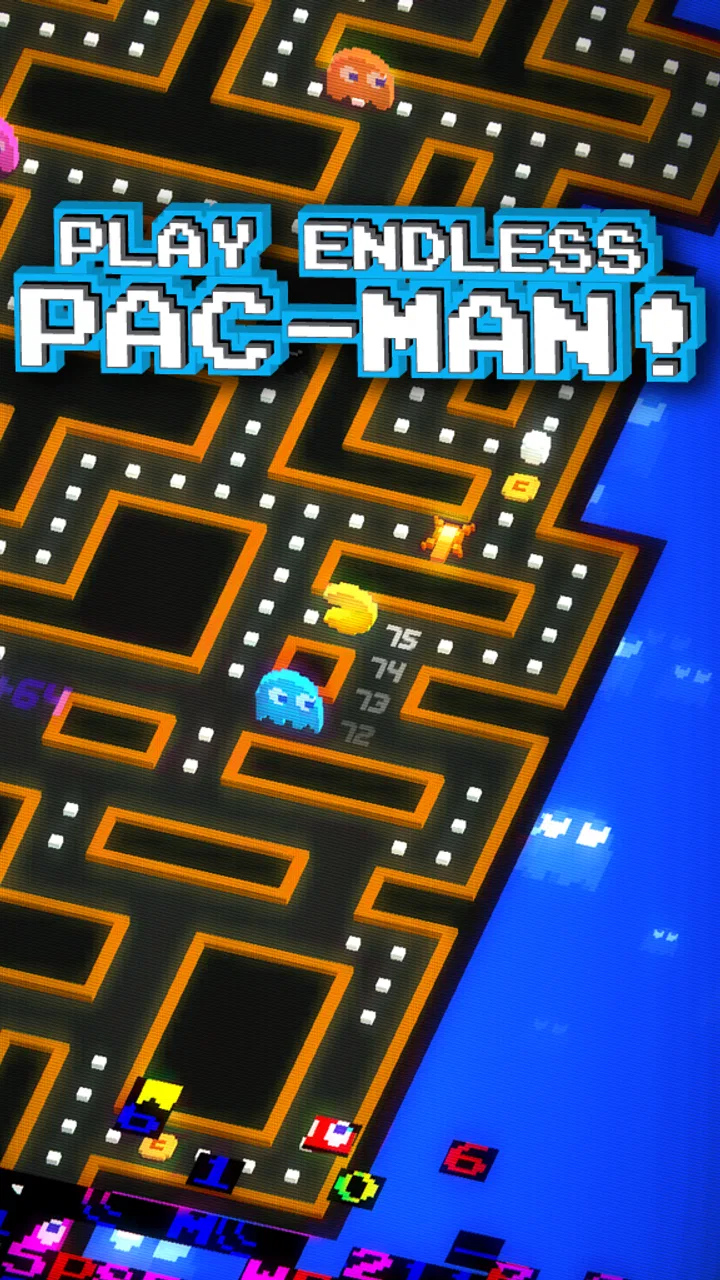
The endless maze in PAC-MAN 256 is designed to keep players engaged with infinite gameplay. As you navigate, the maze continuously regenerates, and a glitch creeps up from the bottom, pushing you forward. This mechanic challenges players to strategize their moves and maintain momentum to avoid the advancing glitch.
Pros
- Nostalgic visuals with a modern twist.
- Endless gameplay keeps it fresh.
- Smooth controls enhance experience.
- Fun power-ups add excitement.
- Offline play is available.
Cons
- In-app purchases can be pricey.
- Ads can interrupt gameplay.
- Limited character customization.
- Repetitive music may annoy some.
- Difficulty spikes unexpectedly.

PAC-MAN 256 - Endless Maze
Gallery